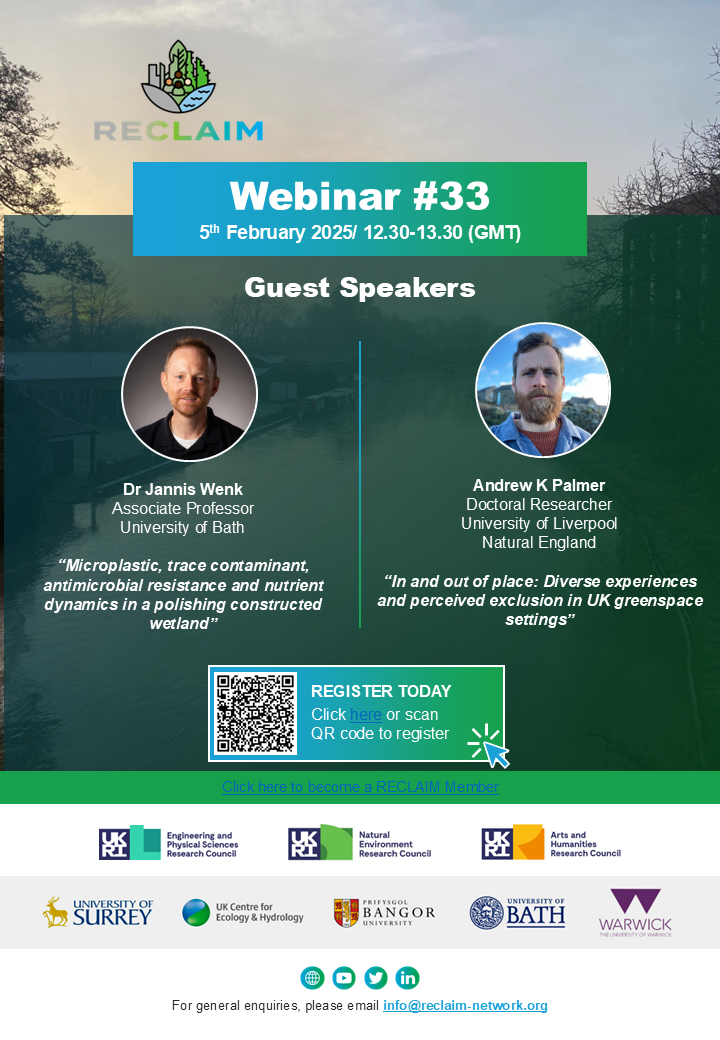
This webinar included two speakers:
Dr Jannis Wenk, Senior Lecturer, University of Bath: Seasonal microbial community, pharmaceutical and antimicrobial resistance dynamics in a full-scale surface flow polishing constructed wetland
Andrew K Palmer, Doctoral Researcher, University of Liverpool: In and out of place: Diverse experiences and perceived exclusion in UK greenspace settings
Speakers

Dr Jannis Wenk
Senior Lecturer, University Bath
Title of the talk:
"Microplastic, trace contaminant, antimicrobial resistance and nutrient dynamics in a polishing constructed wetland”
Biography :
Dr Jannis Wenk is a Senior Lecturer (Associate Professor) in Water Science and Engineering at the Department of Chemical Engineering, University of Bath, UK. He holds a Dipl.-Ing. in environmental engineering from TU Berlin (2008) and a PhD in environmental sciences from ETH Zurich/Eawag, Switzerland (2013). Dr Wenk's research focuses on water treatment process engineering for drinking water and wastewater treatment, particularly oxidative water treatment via ozonation and nature-oriented water treatment, such as constructed wetlands. He collaborates with several UK water utilities on real-world water treatment solutions. Dr Wenk has published 70 peer-reviewed articles (3400 citations; H-index 27). Notable awards include the 'Highly commended' Excellence in Doctoral Supervision Prize of the University of Bath in 2023 and an Outstanding Reviewer award for ‘Water Research’.
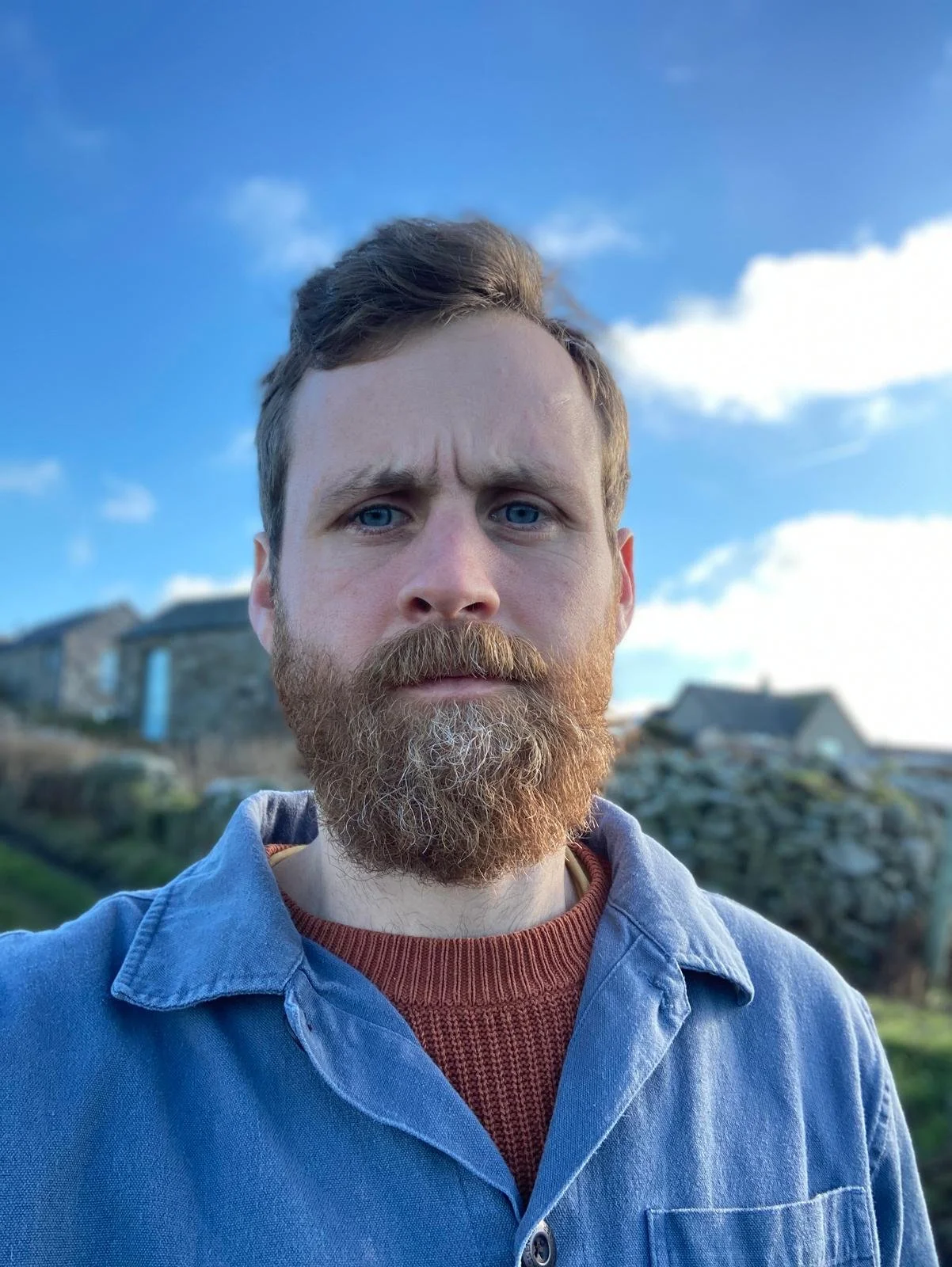
Andrew K Palmer
Doctoral Researcher, University of Liverpool
Title of the talk:
“In and out of place: Diverse experiences and perceived exclusion in UK greenspace settings”
Biography:
Andrew K Palmer is a doctoral researcher at the University of Liverpool's Department of Geography and Planning, conducting CASE partnership research with Natural England. His research examines how UK ethnic minority communities perceive and engage with natural spaces, with particular focus on understanding what constitutes ‘quality’ in greenspace experiences. Through collaboration with Forest Research, he also investigates young people's sociocultural values of trees outside woodland. His work combines qualitative and mixed methods approaches to explore how different social and cultural groups experience, interact and derive benefits from natural spaces.